Water
Saltwater beaches in Jammerbugt (part of the North Sea). Salinity 30–35 o/oo. Water temperature varies between approximately 12°C and 20°C during bathing season. Beach width varies between approximately 80 and 100 metres. Sandy seabed. Most days exhibit surf and strong undertow caused by relatively great water depth close to shore.
Location
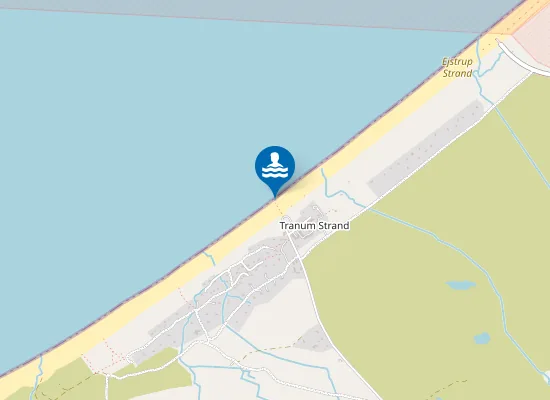
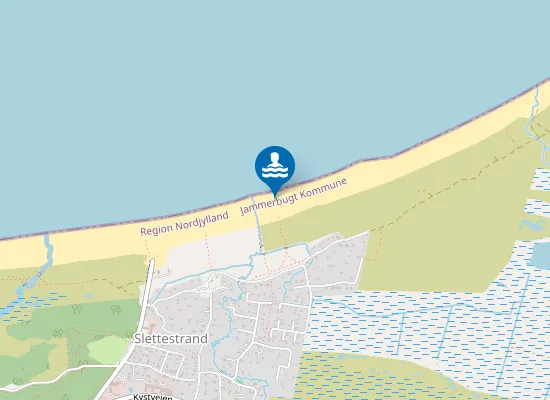
Jammerbugt Kommune, southern Jammerbugt, Denmark. Ejstrup Strand: accessed via Sandmosevej, parking for approximately 20 cars at the road or on the beach. Tranum Strand: accessed via Strandvejen, parking for approximately 40 cars, vehicle-free beach. Slette Strand: accessed via Slette Strandvej, parking for approximately 30 cars, vehicle-free beach. GPS coordinates: Ejstrup 57.17713/9.43845, Tranum 57.16906/9.41906, Slettestrand 57.15516/9.36456.
Facilities
Ejstrup Strand: toilets, rescue rings (summer), waste bins (summer), parking, waste sorting, camping site approximately 1 km away. Tranum Strand: vehicle-free beach, toilets, parking, ramp from parking to water's edge, rescue rings (summer), waste bins (summer), restaurant, boat builder, fishing boats, bunkers. Slette Strand: vehicle-free beach, handicap-accessible beach, ramp from parking to water's edge, toilets, handicap toilet, rescue rings (summer), waste bins (summer), waste sorting, kiosk and shop, boat builder, natural scenery.
Season
Monitoring and facility provision during bathing season (summer period). Rescue rings and waste bins available during summer half-year.
Water Quality
Water quality classified as 'excellent' at all three beaches based on E. coli and enterococcus data from 2007–2017. This is the highest possible classification. Municipal bathing water analyses for the preceding five years show stable conditions with bacterial concentrations generally very low and far below the limit for satisfactory bathing water quality.
Risks
Risk of strong algal blooms of microscopic algae in bathing season, particularly Phaeocystis (April–July, foam-forming) and Noctiluca (July–August, discolours water). Risk of sea fire (stinging jellyfish) during bathing season, highest during offshore wind periods. Low risk of large seaweed accumulations, though minor amounts may occur locally. Low risk of chemical pollution from oil spills affecting bathers' health. No risk of blue-green algae blooms due to high salinity.